Showing posts with label trai. Show all posts
Showing posts with label trai. Show all posts
Saturday, 20 January 2018
Sunday, 30 July 2017
India's Telecom Policy Contrived to be Fitting with Next Gen Era.

The DoT is in process of formulating a National Telecom Policy that will focus on areas such as Internet for all, next-generation technologies like 5G and Internet of Things (IoT), skills development, and security, among others.
The discussions held a week ago were around policy and regulatory framework, spectrum framework, security requirements for telecom networks, ease of doing business, and even manufacturing and exports. Ideas around cloud economic zones, aligning of the Center and states to achieve telecom objectives, and devising network and regulations for IoT devices, were mooted.
The DoT plans to go for a wide consultation and outreach before finalizing the new policy.
The Department of Telecom (DoT) has already held its first round of discussions with operators, industry associations and research organisations on the broad contours and key focus areas under the new telecom policy, which the government wants to bring in by 2018.
"We're expecting the draft of the new telecom policy to be out by December, the working groups are being created as we speak," telecom secretary Aruna Sundararajan said on the sidelines of a CII event on fintech.
DoT plans a wide consultation and outreach before finalising the new policy, and has said it will invite views from the likes of Apple, Google and Amazon, along with the Telecom Regulatory Authority of India (Trai), during consultations on NTP. It will also seek views of the public at large.
Source HERE.
Wednesday, 26 July 2017
Biased TRAI (indian regulator), Where the benefits?
Trai has held discussions on the latest IUC consultation paper, including a special workshop on the costing model each telco has, and an open house discussion. It has said it will give its recommendations soon.
Earlier TRAI recommended govt to levy a Rs 1,050-crore penalty on the carrier for allegedly not providing adequate points of interconnect to Jio, against which Vodafone has knocked the court.
This time Vodafone has against filed petition against TRAI for debunking over IUC (Interconnect uses charges) issues. This one is the second such case on IUC that the telco has filed against Trai. The first instance was in November 2015, when Vodafone challenged Trai's move to reduce IUC to 14 paise per minute from 20.
It’s a transparency petition… since it is incumbent upon the regulator to share cost models with all the stakeholders, in its consultation process, which they have not done, despite repeated requests,” said a legal executive who has seen the petition.
“Since they haven’t shared the cost model, it is violation of principles of natural justice… It is also violating Section 11 (4) of the Trai Act, which provides that in carrying out functions of Trai, it must do so transparently,” the person, who did not wish to be named, said. The matter is set for a Friday hearing.
Section 11 (4) of the Trai Act, 1997, states that “the Authority shall ensure transparency while exercising its powers and discharging its functions”.
Vodafone India has taken the ground of transparency, after the Supreme Court had struck down a Trai regulation that made it mandatory for telcos to compensate subscribers for call drops, holding it as “arbitrary, unreasonable and non-transparent“.
original news from HERE
Earlier TRAI recommended govt to levy a Rs 1,050-crore penalty on the carrier for allegedly not providing adequate points of interconnect to Jio, against which Vodafone has knocked the court.
This time Vodafone has against filed petition against TRAI for debunking over IUC (Interconnect uses charges) issues. This one is the second such case on IUC that the telco has filed against Trai. The first instance was in November 2015, when Vodafone challenged Trai's move to reduce IUC to 14 paise per minute from 20.
It’s a transparency petition… since it is incumbent upon the regulator to share cost models with all the stakeholders, in its consultation process, which they have not done, despite repeated requests,” said a legal executive who has seen the petition.
“Since they haven’t shared the cost model, it is violation of principles of natural justice… It is also violating Section 11 (4) of the Trai Act, which provides that in carrying out functions of Trai, it must do so transparently,” the person, who did not wish to be named, said. The matter is set for a Friday hearing.
Section 11 (4) of the Trai Act, 1997, states that “the Authority shall ensure transparency while exercising its powers and discharging its functions”.
Vodafone India has taken the ground of transparency, after the Supreme Court had struck down a Trai regulation that made it mandatory for telcos to compensate subscribers for call drops, holding it as “arbitrary, unreasonable and non-transparent“.
original news from HERE
Friday, 7 July 2017
Indian telecom regulator has invited all companies, app providers and hardware or software providers, for setting up a pilot project of public wi-fi hotspots
Source : ETTelecom
Indian telecom regulator has invited all companies, app providers and hardware or software providers, for setting up a pilot project of public Wi-Fi hotspots - which it calls as Public Data Offices (PDOs) - which will allow pay-as-you-go 'sachet sized' wi-fi facilities priced between Rs 2 and Rs 20, making internet access affordable for the common public.
PDOs will be akin to the public calling offices (PCOs) that connected all of India before the advent of low cost mobile phones and low cost telecom services, the Telecom Regulatory Authority of India (Trai) said Friday, while issuing the broad objectives of the pilot program, the guidelines and pre-requisites for companies who want to participate.
"TRAI invites all interested entities to be a part of this Pilot to establish nation-wide, pay-as-you-go PDOs," the regulator said. “The products available for consumption should begin from “sachet-sized”, i.e. low denominations ranging from INR 2 to INR 20, etc,” the Trai added.
The pilot will help in identifying the positives and problem areas before national proliferation of such hotspots.
The vision of this initiative is to establish an open architecture based Wi-Fi Access Network Interface (WANI), which will allow users to do one-time enrollment into the service through KYC and mobile one time password, and access through purchase of sachet sized data packs.
This will bring in new customers and boost the consumption of data by the price sensitive Indian customer who rations her cellular data usage, the regulator added. Participants have been asked to send their details by July 25.
Through this plan, the broad objective of the regulator is to have multiple hotspots available for the public to use at multiple locations across the country, allowing data use in last mile connectivity.
The regulator also envisions that the hotpots will be able to offload data pressure from existing telecom networks given that only limited number of towers or routers can be added at every locality, enough to support the growing data usage owing to low cost tariffs. The hotspot plan will also take the total number of hotspots in India up from the present 31,000, abysmally lower than 10 million in US and 13 million in France.
"Overall, these suggestions encourage the PDOs to become bustling centers of economic activity, where consumption of data for the average Indian becomes as common as consuming a cup of hot chai," the regulator said.
The pilot program will aim to prove that multi-provider, inter-operable and collaborative model increases the overall innovation in the system, dismantles monopolies and encourages passing of benefits to end user. The pilot will also test out integrated payment methods such as coupons - purchased using cash by user or gifted to user – credit or debit cards, net banking, e-wallets, and Unified Payments Interface.
The regulator will issue WANI Technology Architecture document within three to four days, which will provide the necessary technology and architecture for allowing multi-provider, interoperable system across the country.
Trai aims to provide a simplified, consistent experience across hotspots from various providers, which would mean unbundling authentication, payment and accounting from hardware and software running on the access point.
This will allow small entrepreneurs such as tea shops, to set up and maintain access points whereas device manufacturers, payment companies, internet and telecom service providers and consumer internet companies can provide the remaining pieces to set up PDOs.
The proposal to set up open public wi-fi hotspots comes after the regulator issued recommendation on “Proliferation of Broadband through Public Wi-Fi Networks” in March this year. The regulator had recommended setting up public Wi-Fi hotspots, reducing import duty on Wi-Fi equipment, infrastructure sharing and authentication of the users through eKYC process.
It had also suggested that Public Data Office Aggregators (PDOAs) should be allowed to provide public Wi-Fi services without obtaining any licence, but should be subject to telecom department prescribed registration requirements, including ensuring that e-KYC, authentication and record keeping of customers, devices and PDOAs enlisted with the PDOs.
 |
| Fundarc Communication |
Indian telecom regulator has invited all companies, app providers and hardware or software providers, for setting up a pilot project of public Wi-Fi hotspots - which it calls as Public Data Offices (PDOs) - which will allow pay-as-you-go 'sachet sized' wi-fi facilities priced between Rs 2 and Rs 20, making internet access affordable for the common public.
PDOs will be akin to the public calling offices (PCOs) that connected all of India before the advent of low cost mobile phones and low cost telecom services, the Telecom Regulatory Authority of India (Trai) said Friday, while issuing the broad objectives of the pilot program, the guidelines and pre-requisites for companies who want to participate.
"TRAI invites all interested entities to be a part of this Pilot to establish nation-wide, pay-as-you-go PDOs," the regulator said. “The products available for consumption should begin from “sachet-sized”, i.e. low denominations ranging from INR 2 to INR 20, etc,” the Trai added.
The pilot will help in identifying the positives and problem areas before national proliferation of such hotspots.
The vision of this initiative is to establish an open architecture based Wi-Fi Access Network Interface (WANI), which will allow users to do one-time enrollment into the service through KYC and mobile one time password, and access through purchase of sachet sized data packs.
This will bring in new customers and boost the consumption of data by the price sensitive Indian customer who rations her cellular data usage, the regulator added. Participants have been asked to send their details by July 25.
Through this plan, the broad objective of the regulator is to have multiple hotspots available for the public to use at multiple locations across the country, allowing data use in last mile connectivity.
The regulator also envisions that the hotpots will be able to offload data pressure from existing telecom networks given that only limited number of towers or routers can be added at every locality, enough to support the growing data usage owing to low cost tariffs. The hotspot plan will also take the total number of hotspots in India up from the present 31,000, abysmally lower than 10 million in US and 13 million in France.
"Overall, these suggestions encourage the PDOs to become bustling centers of economic activity, where consumption of data for the average Indian becomes as common as consuming a cup of hot chai," the regulator said.
The pilot program will aim to prove that multi-provider, inter-operable and collaborative model increases the overall innovation in the system, dismantles monopolies and encourages passing of benefits to end user. The pilot will also test out integrated payment methods such as coupons - purchased using cash by user or gifted to user – credit or debit cards, net banking, e-wallets, and Unified Payments Interface.
The regulator will issue WANI Technology Architecture document within three to four days, which will provide the necessary technology and architecture for allowing multi-provider, interoperable system across the country.
Trai aims to provide a simplified, consistent experience across hotspots from various providers, which would mean unbundling authentication, payment and accounting from hardware and software running on the access point.
This will allow small entrepreneurs such as tea shops, to set up and maintain access points whereas device manufacturers, payment companies, internet and telecom service providers and consumer internet companies can provide the remaining pieces to set up PDOs.
The proposal to set up open public wi-fi hotspots comes after the regulator issued recommendation on “Proliferation of Broadband through Public Wi-Fi Networks” in March this year. The regulator had recommended setting up public Wi-Fi hotspots, reducing import duty on Wi-Fi equipment, infrastructure sharing and authentication of the users through eKYC process.
It had also suggested that Public Data Office Aggregators (PDOAs) should be allowed to provide public Wi-Fi services without obtaining any licence, but should be subject to telecom department prescribed registration requirements, including ensuring that e-KYC, authentication and record keeping of customers, devices and PDOAs enlisted with the PDOs.
Saturday, 10 June 2017
Indian Telecom on IoT technologies : Industry is looking forward to orchestration of standards, infrastructure and policy framework.
Source : ETTelecom
As India has slowly started to emerge as a global destination for many of the IoT technologies, the industry is looking forward to orchestration of standards, infrastructure and policy framework in order to generate new business models and accelerate the adoption of technology.
Being the providers of network connectivity, telecom operators will play a crucial role in the process especially in M2M communication which would require operators to work around new rating plans and ensure seamless connectivity.
“Network providers have to see how they will ensure different kinds of rating plans and accessibility so that the transfer of data happens seamlessly between machines and for this new kinds of rating plans will be required,” said Rishi Mohan Bhatnagar, President, Aeris India and Chairman IET IoT Panel in an interaction with ET.
“In India, we also need to ensure a technology and legal framework that will allow machines to migrate network,” added Bhatnagar.
Meanwhile, exploring alternate solutions and technologies is as important for operators and some of them have already started working on it.
“Today techies are working not only on the GSM, 2G, 3G, 4G or 5G but also on other technologies like LoRa, narrow-band and ZigBee. Tata Communications has already implemented the LoRa network in Jamshedpur and they're trying to do some tests,” told Bhatnagar.
The industry believes that as far as the challenges of Internet of Things are concerned, the first challenge lies on the front of standards and interoperability.
“There is a lot of hard work to be done whether it is in the evolution of standards, or putting together the necessary infrastructure, aligning the industry and making sure that new business models emerge. We need to ensure that the new collaborations are forged between the government, academia and industry,” said IT Secretary Aruna Sundararajan at an IoT event.
Another challenge lies in terms of India’s cultural diversity and the huge population that the technologies have to cater to but at the same time IoT is a solution to many of India’s problems in sectors such as healthcare and energy.
“There is no solution in the western world which would be applicable for India as the way it is. India's challenge is huge mass. For the mass that we have to cater, the only way is Internet of Things technology,” expressed Bhatnagar.
Recent findings by the IoT World Forum (IoTWF) also suggested that while IoT sounds like it is all about technology, human factors like culture, organisation and leadership are critical.
While IoT helps people to get connected using sensors, controllers, devices which are capturing the data but the heart of IoT lies in analyzing the collected data, experts believe.
IoT units in India are expected to see a 31-fold growth to reach 1.9 billion by 2020 owing to advances in reliability, accuracy and technology of advance tech measures, as predicted by Deloitte.
Currently in India, telecom operators like Bharti Airtel and Vodafone are offering IoT solutions such as location tracker, automative telematics, smart metering, security and surveillance solutions, and managed IoT connectivity platform among others.
As India has slowly started to emerge as a global destination for many of the IoT technologies, the industry is looking forward to orchestration of standards, infrastructure and policy framework in order to generate new business models and accelerate the adoption of technology.
Being the providers of network connectivity, telecom operators will play a crucial role in the process especially in M2M communication which would require operators to work around new rating plans and ensure seamless connectivity.
“Network providers have to see how they will ensure different kinds of rating plans and accessibility so that the transfer of data happens seamlessly between machines and for this new kinds of rating plans will be required,” said Rishi Mohan Bhatnagar, President, Aeris India and Chairman IET IoT Panel in an interaction with ET.
“In India, we also need to ensure a technology and legal framework that will allow machines to migrate network,” added Bhatnagar.
Meanwhile, exploring alternate solutions and technologies is as important for operators and some of them have already started working on it.
“Today techies are working not only on the GSM, 2G, 3G, 4G or 5G but also on other technologies like LoRa, narrow-band and ZigBee. Tata Communications has already implemented the LoRa network in Jamshedpur and they're trying to do some tests,” told Bhatnagar.
The industry believes that as far as the challenges of Internet of Things are concerned, the first challenge lies on the front of standards and interoperability.
“There is a lot of hard work to be done whether it is in the evolution of standards, or putting together the necessary infrastructure, aligning the industry and making sure that new business models emerge. We need to ensure that the new collaborations are forged between the government, academia and industry,” said IT Secretary Aruna Sundararajan at an IoT event.
Another challenge lies in terms of India’s cultural diversity and the huge population that the technologies have to cater to but at the same time IoT is a solution to many of India’s problems in sectors such as healthcare and energy.
“There is no solution in the western world which would be applicable for India as the way it is. India's challenge is huge mass. For the mass that we have to cater, the only way is Internet of Things technology,” expressed Bhatnagar.
Recent findings by the IoT World Forum (IoTWF) also suggested that while IoT sounds like it is all about technology, human factors like culture, organisation and leadership are critical.
While IoT helps people to get connected using sensors, controllers, devices which are capturing the data but the heart of IoT lies in analyzing the collected data, experts believe.
IoT units in India are expected to see a 31-fold growth to reach 1.9 billion by 2020 owing to advances in reliability, accuracy and technology of advance tech measures, as predicted by Deloitte.
Currently in India, telecom operators like Bharti Airtel and Vodafone are offering IoT solutions such as location tracker, automative telematics, smart metering, security and surveillance solutions, and managed IoT connectivity platform among others.
Indian IT : Taking the country to $1 trillion digital economy by 2022.
Source : ETTelecom
Minister of electronics and IT Ravi Shankar Prasad will hold a high level roundtable on June 16 with chief executives of telecom, IT, banking, fintech and other industries to chart a roadmap of taking the country to $1 trillion digital economy by 2022.
The IT ministry’s meeting comes alongside the telecom ministry’s outreach to the telecom industry. Telecom minister Manoj Sinha is expected to meet top telecom leaders on June 22 to discuss the current state of financial stress in the sector.
“The government has partnered with the industry in the design of new services and platforms like MyGov, Digital Locker, E-sign, cloud services, Government eMarketplace, eNational Agricultural Markets, etc… It is time to take this partnership to the next level,” said people aware of the intimations sent out by the ministry of electronics and IT (Meity) to key industry executives.
The government aims to increase the partnership with the private sector to create new business opportunities and jobs, as it takes steps towards use of technology for enlarging the purview of the government’s Digital India program.
Sources aware of the meeting said that the department will take views from heads of various companies across industries to develop a program that will become the blueprint for increasing the use of digital services for multiple purposes including making financial transactions.
Part of the agenda will also be discussions on issues plaguing the sector, such as concern over jobs in the IT sector, which have been slowing due to shifts in technology, automation and growing protectionism in developed markets. The issue of the US government reviewing the H1-B visa program may also be discussed. The discussions, sources said, will include ways to find solutions to these issues among other things.
In a separate development, the telecom minister Manoj Sinha will hold meeting with telecom leader including Sunil Bharti Mittal, Kumar Mangalam Birla and Anil Ambani, for understanding financial problems being faced by the sector that has a debt of nearly Rs 5 lakh crore.
The meeting will take place after the inter-ministerial group (IMG) – created to resolve financial woes of the telecom sector – completes its company-wise meetings.
The IMG has called Reliance Communications, Tata Teleservices, Aircel and Sistema Shyam Teleservices for a meeting on June 12. The other major players -- Bharti Airtel, Reliance Jio, Vodafone and Idea -- have been asked for a meeting on June 15 by the panel, while state run carriers will be called on June 17, ET had reported previously.
Minister of electronics and IT Ravi Shankar Prasad will hold a high level roundtable on June 16 with chief executives of telecom, IT, banking, fintech and other industries to chart a roadmap of taking the country to $1 trillion digital economy by 2022.
The IT ministry’s meeting comes alongside the telecom ministry’s outreach to the telecom industry. Telecom minister Manoj Sinha is expected to meet top telecom leaders on June 22 to discuss the current state of financial stress in the sector.
“The government has partnered with the industry in the design of new services and platforms like MyGov, Digital Locker, E-sign, cloud services, Government eMarketplace, eNational Agricultural Markets, etc… It is time to take this partnership to the next level,” said people aware of the intimations sent out by the ministry of electronics and IT (Meity) to key industry executives.
The government aims to increase the partnership with the private sector to create new business opportunities and jobs, as it takes steps towards use of technology for enlarging the purview of the government’s Digital India program.
Sources aware of the meeting said that the department will take views from heads of various companies across industries to develop a program that will become the blueprint for increasing the use of digital services for multiple purposes including making financial transactions.
Part of the agenda will also be discussions on issues plaguing the sector, such as concern over jobs in the IT sector, which have been slowing due to shifts in technology, automation and growing protectionism in developed markets. The issue of the US government reviewing the H1-B visa program may also be discussed. The discussions, sources said, will include ways to find solutions to these issues among other things.
In a separate development, the telecom minister Manoj Sinha will hold meeting with telecom leader including Sunil Bharti Mittal, Kumar Mangalam Birla and Anil Ambani, for understanding financial problems being faced by the sector that has a debt of nearly Rs 5 lakh crore.
The meeting will take place after the inter-ministerial group (IMG) – created to resolve financial woes of the telecom sector – completes its company-wise meetings.
The IMG has called Reliance Communications, Tata Teleservices, Aircel and Sistema Shyam Teleservices for a meeting on June 12. The other major players -- Bharti Airtel, Reliance Jio, Vodafone and Idea -- have been asked for a meeting on June 15 by the panel, while state run carriers will be called on June 17, ET had reported previously.
Wednesday, 7 June 2017
Indian Telecom industry is at its weakest, govt will have to step in.
Source : Business standards

The industry is now composed of three sets of players:
1) Established incumbents like Bharti, Vodafone and Idea Cellular which have executed well in the past and have strong brands. Vodafone merger with Idea will solve the capacity constraints of both the players
2) Weaker players like Telenor, MTS, RCOM, BSNL, MTNL and Aircel which are exiting or are consolidating for survival. Even after consolidation, the operators ability to invest will pose a challenge
3) Reliance Jio which has defined the technological and strategic landscape.
In future, the industry will see slower investments and more consolidation. With so much supply in the market, revenue will grow with usage albeit with a lag. We expect 11 per cent revenue CAGR over the next 5 years but most of the growth will be back ended post industry consolidation. The weaker players will have to exit but their debt presents a structural problem for an exit. In this regard, the government might need to step in to improve the industry profitability to ease the exit of players and solve the structural debt issue. The government has many levers to improve the industry profitability which include reducing service tax to spectrum usage charges. All or any of these measures can improve the industry profitability significantly.
1) Established incumbents like Bharti, Vodafone and Idea Cellular which have executed well in the past and have strong brands. Vodafone merger with Idea will solve the capacity constraints of both the players
2) Weaker players like Telenor, MTS, RCOM, BSNL, MTNL and Aircel which are exiting or are consolidating for survival. Even after consolidation, the operators ability to invest will pose a challenge
3) Reliance Jio which has defined the technological and strategic landscape.
In future, the industry will see slower investments and more consolidation. With so much supply in the market, revenue will grow with usage albeit with a lag. We expect 11 per cent revenue CAGR over the next 5 years but most of the growth will be back ended post industry consolidation. The weaker players will have to exit but their debt presents a structural problem for an exit. In this regard, the government might need to step in to improve the industry profitability to ease the exit of players and solve the structural debt issue. The government has many levers to improve the industry profitability which include reducing service tax to spectrum usage charges. All or any of these measures can improve the industry profitability significantly.
Finally, little help from regulator
The Indian telecom industry is at a critical juncture and faster improvement in profitability will be crucial for long-term health of the sector. Industry consolidation is critical but government interventions to improve industry profitability will help the sector immensely. The Indian telecom sector has immense potential for growth but realising the potential is in the hands of government and regulator.
Saturday, 27 May 2017
Indian Telecom: Are they on right track- This is where VoLTE be placed?
Source ETTelecom
Airtel, Vodafone & Idea to soon launch VoLTE to protect low-end subscriber base
Launching such services could become critical to protect incumbents’ low-end subscriber base who could move out to Reliance Jio which is running an all-VoLTE network and offers voice for free.
An Airtel spokesperson said that the telco is piloting VoLTE in a few places, but didn’t comment on launch timelines. Vodafone and Idea didn't comment on ET queries, but Idea managing director Himanshu Kapania recently said that the No. 3 telco would introduce VoLTE over the next two quarters. “We are initially planning to be able to build VoLTE for about 20-25 million customers, which is sufficient enough to be able to take care of our 4G expectations in volume in India.”
Having finished testing, Idea Cellular expects to launch its VoLTE services by the second quarter (July-September) of this fiscal and cover 20-25 million customers.
Rohan Dhamija, partner and head for India and South Asia at Analysys Mason, said that VoLTE device proliferation outside of Jio’s base is probably not at a critical mass, a reason why Airtel and other incumbents haven’t launched VoLTE service yet.
“In fact, given that VoLTE has a lower cost per minute than traditional voice, in a scenario where the industry is under tremendous pricing pressure, in due course the importance of VoLTE could increase,” Dhamija said, adding that telcos should continue with VoLTE testing and be ready to launch commercially once device proliferation reaches critical mass.Launching such services could become critical to protect incumbents’ low-end subscriber base who could move out to Reliance Jio which is running an all-VoLTE network and offers voice for free. Analysts add that in a scenario where the industry is under tremendous pricing pressure, VoLTE is set gain in importance as it can be delivered at a lower cost per minute than traditional voice.
“Airtel’s VoLTE plans are on track having kicked off field or commercial trials in Mumbai and Delhi, and it will soon launch the service commercially in India,” a person familiar with the matter told ET. Another person said that Vodafone did basic trials of the technology, and will launch VoLTE services soon.
VoLTE allows an operator to offer both voice and data with voice being just another application that rides on an LTE data network, a technology that newcomer Jio has adopted. Incumbents currently offers calling on the legacy circuit-switch technology.detail News click HERE.
TRAI- Bars discriminatory tariffs to same set of subscribers-Monkey business in Indian telecom.
Source : ETTelecom.
TRAI - Telecom Regulatory Authority of India
NEW DELHI: India’s telecom regulator has barred mobile-phone operators from offering different plans to subscribers in the same category, limiting the ability of incumbent telcos to sell customised plans to retain customers seeking to switch their loyalties to Reliance Jio.
“The authority directs all the Access Service Providers to ensure that all the tariffs offered to the consumers shall not be discriminatory between the subscribers of the same class, and to ensure that every tariff that is offered to a customer is invariably reported to the authority as per the reporting framework under the forbearance regime,” the Telecom Regulatory Authority of India (Trai) said in a two-page order Thursday.
The existing rules require telcos to report all plans to Trai within seven working days of introducing them.
Thursday’s order means that the telcos, although free to offer any plan to any customer on clearance from Trai, would not be able to offer customized packs to an individual subscriber: The moment an order is filed for clearance with the regulator, it becomes available to all. Besides, the order takes away the advantage of bespoke plans for a telco, or the confidentiality of such offers.
Moreover, incumbents have hundreds of existing plans, and the approval for each additional plan could lead to breaching the limit of up to 25 plans a month that a carrier can file with Trai. Jio, which started commercial services on September 5 last year, has a limited number of plans on offer.
Trai Thursday said it had received complaints that some service providers were introducing tariffs without filing them with the regulator, and that they were offering “discriminatory tariff to individual customers within the same class”.
The directions issued in the form of a tariff order came after complaints to Trai from Reliance Jio that Bharti Airtel, Vodafone India and Idea were offering special tariff vouchers (STV), packs and discounts to influence those users wanting to shift out of their networks to Jio. The Reliance-owned Jio and the three incumbent service providers are engaged in a price war to attract and retain users.
Bharti Airtel, Vodafone India and Idea had previously denied all allegations, claiming they were in full compliance of regulatory guidelines, including tariff orders and MNP (mobile number portability) regulations. The companies didn’t comment on the regulator’s order Thursday.
Officials at Trai said that besides the letter from Jio, they had received complaints from consumers who had referred to or contested plans that were not available on the Web sites of the telcos.
The Mukesh Ambani-owned carrier had highlighted the lack of transparency in tariff offers last month, and accused the incumbent competition of making surreptitious, personalised offers to select consumers in violation of existing rules.
Jio had alleged that some telcos were offering special tariff plans to select customers to prevent them from porting "under the garb of usage and retention," adding that some of these offers were being communicated to consumers in a personalised way through 10-digit mobile numbers, instead of being published. The practice violated current rules, Jio said.
Jio added that the actions of the rival telcos violated the tariff reporting requirements and breached the monthly permissible limit of 25 plans (prepaid and postpaid).
Jio had also alerted Trai about two of Bharti Airtel’s tariff offers (Rs 293 and Rs 449), complaining that the Sunil Mittal-owned telco was discriminating between 4G and other subscribers. It claimed that Airtel was providing headline benefits only to new subscribers with 4G handsets, while others were being given substantially lower benefits on both data and voice services.
The allegations intensified an ongoing war of words between Jio and the incumbent telcos, who have been fighting on issues such as trial of services, points of interconnection, and interconnect charges since the newcomer's entry last September.
click HERE for original news from ETTelecom.
Disruptive players in broadband speed challenging the big bees, A trend TSPs space to be watched for.
Source : ETTelecom
The emergence of new players in the telecom industry may have signalled an era of free services, but whether that has led to better quality is arguable.
Free voice calls and economical data plans notwithstanding, patchy networks often come in the way of a buffer-free experience for users.
While big telcos are working out piecemeal solutions to improve the efficiency of their networks, a Bangalore-based startup has been leveraging these inconsistencies to create a service that few businesses - or the government - can turn down.
Wired right
Started as a live-streaming service for internal events of big organizations, ZifiLink - that went by the name 'Watchy Technology' - has morphed into a full-fledged product company that seeks to democratize reliable, high-speed internet by combining multiple networks and streaming it through one source. In simple terms it combines the data bandwidth of all the telecom players to provide super fast data speeds.
The company's flagship product works as a portable WiFi router that converges eight different telecom networks - be it Airtel, Vodafone or any other - to provide one ultra-fast internet connection, eliminating the need for expensive leased lines.
"ZifiLink 's system aggregates 3G or 4G links from eight dongles across networks to create a combined capacity that increases the reliability by a factor of eight," says founder & CEO of ZifiLink, Sriramkumar. "Even if bad weather attenuates one signal, the combination of the rest will still give users sustainable Internet," he adds. ZifiLink customers say that have got speeds of 40 Mbps using ZifiLink.
Spreading the web
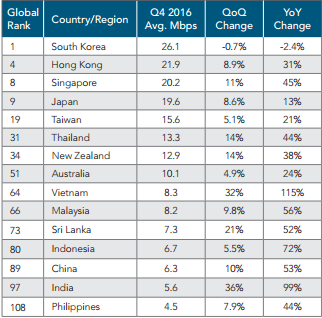
When it comes to Internet speeds, South Korea is the leader with an average of 26.1 Mbps. India has one of the lowest average connection speeds among countries in the Asia Pacific region at 5.6 Mbps.
Average Connection Speed by APAC Country/Region (Source - Akamai)
Although the applicability of ZifiLink offers a broad scope for the imagination, the startup sees a good start in taking the B2B route. While established enterprises can use it as a cheaper alternative to premium satellite-based solutions, it also solves the pain point of SMEs who are eager to reap the opportunities high-speed internet can bring to their businesses.
In addition to small companies in tier-2 cities, media companies also see a compelling value proposition in this product.
"ZifiLink can - and has - replaced expensive OB van needs by enabling fast WiFi connection inside any vehicle," says the 33-year-old entrepreneur. "Media is also increasingly moving towards using smartphones to stream content back to the studio. This creates an imperative need to have high-speed connectivity with you at all times without compromising on mobility - which is often stymied when depending on these vans. Moreover, the device is compact and can easily fit into a backpack," he adds.
The same vehicle-friendly application can be used by law enforcement agencies to connect their surveillance cameras to the control room. "Chennai police has used our product to get a seamless feed from PTC cameras during sensitive times like elections," he says.
Big organzations like Hindustan Petroleum (HP) are also cashing in on the cost-effective solutions that ZifiLink is offering by replacing the VSAT terminals at its petrol pumps with this product.
"HP has a large number of petrol pumps on the highways which need to be connected to ERP systems to ensure uninterrupted supply - a loss of even two hours would be equivalent to losing money in lakhs," he says. "With ZifiLink, these companies can get 100 times the speed of internet for less the cost of VSAT terminals which they currently depend on," he adds.
For more click HERE
The emergence of new players in the telecom industry may have signalled an era of free services, but whether that has led to better quality is arguable.
Free voice calls and economical data plans notwithstanding, patchy networks often come in the way of a buffer-free experience for users.
While big telcos are working out piecemeal solutions to improve the efficiency of their networks, a Bangalore-based startup has been leveraging these inconsistencies to create a service that few businesses - or the government - can turn down.
Wired right
Started as a live-streaming service for internal events of big organizations, ZifiLink - that went by the name 'Watchy Technology' - has morphed into a full-fledged product company that seeks to democratize reliable, high-speed internet by combining multiple networks and streaming it through one source. In simple terms it combines the data bandwidth of all the telecom players to provide super fast data speeds.
The company's flagship product works as a portable WiFi router that converges eight different telecom networks - be it Airtel, Vodafone or any other - to provide one ultra-fast internet connection, eliminating the need for expensive leased lines.
"ZifiLink 's system aggregates 3G or 4G links from eight dongles across networks to create a combined capacity that increases the reliability by a factor of eight," says founder & CEO of ZifiLink, Sriramkumar. "Even if bad weather attenuates one signal, the combination of the rest will still give users sustainable Internet," he adds. ZifiLink customers say that have got speeds of 40 Mbps using ZifiLink.
Spreading the web
When it comes to Internet speeds, South Korea is the leader with an average of 26.1 Mbps. India has one of the lowest average connection speeds among countries in the Asia Pacific region at 5.6 Mbps.
Average Connection Speed by APAC Country/Region (Source - Akamai)
Although the applicability of ZifiLink offers a broad scope for the imagination, the startup sees a good start in taking the B2B route. While established enterprises can use it as a cheaper alternative to premium satellite-based solutions, it also solves the pain point of SMEs who are eager to reap the opportunities high-speed internet can bring to their businesses.
In addition to small companies in tier-2 cities, media companies also see a compelling value proposition in this product.
"ZifiLink can - and has - replaced expensive OB van needs by enabling fast WiFi connection inside any vehicle," says the 33-year-old entrepreneur. "Media is also increasingly moving towards using smartphones to stream content back to the studio. This creates an imperative need to have high-speed connectivity with you at all times without compromising on mobility - which is often stymied when depending on these vans. Moreover, the device is compact and can easily fit into a backpack," he adds.
The same vehicle-friendly application can be used by law enforcement agencies to connect their surveillance cameras to the control room. "Chennai police has used our product to get a seamless feed from PTC cameras during sensitive times like elections," he says.
Big organzations like Hindustan Petroleum (HP) are also cashing in on the cost-effective solutions that ZifiLink is offering by replacing the VSAT terminals at its petrol pumps with this product.
"HP has a large number of petrol pumps on the highways which need to be connected to ERP systems to ensure uninterrupted supply - a loss of even two hours would be equivalent to losing money in lakhs," he says. "With ZifiLink, these companies can get 100 times the speed of internet for less the cost of VSAT terminals which they currently depend on," he adds.
For more click HERE
Subscribe to:
Posts (Atom)