What is OpenRoaming?
- Higher quality of service
- No need to track or switch among SSIDs
- A single log-on experience
- Business incentives, primarily through simplicity, to adopters
- Ease of regulatory compliance
- Passive authentication
Fundamental Advance Research Consultancy in Communication (xgnlab) - "Delivering Innovation".
Spectrum harmonisation continues to be important for the mobile industry in the 5G era. Globally harmonised spectrum enables economies of scale and facilitates cross-border coordination and roaming for end users: a critical factor for the initial deployment of 5G. Regulators and the industry should take immediate action towards the following objectives:
1. Spectrum should be allocated to Mobile Service on a primary/co-primary basis globally or regionally,
2. Consistent frequency arrangements (including band plan and duplexing mode) should be adopted across all markets,
3. Consistent regulatory frameworks should be strived for – same technical conditions should govern the use of particular frequency bands (e.g. emission masks ensuring sharing and coexistence with other services in the same band or in adjacent bands),
4. Harmonised standards: the same technology standard should be adopted. ITU-R Working Party 5D is leading the development of IMT-2020 standards and the mobile industry is working on 3GPP 5G-NR as the harmonised standard for 5G.
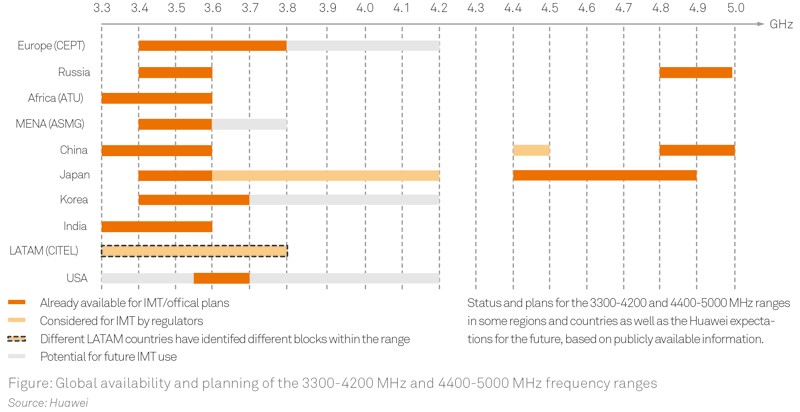
Spectrum availability for IMT in the 3300-4200 and 4400-5000 MHz ranges is increasing globally. The 3400-3600 MHz frequency band is allocated to Mobile Service on a co-primary basis in almost all countries throughout the world. Administrations will make available different portions of the 3300-4200 and 4400-5000 MHz ranges at different times, incrementally building large contiguous blocks.
The 3GPP 5G-NR specification will support 3300-3800 MHz from the start, using a TDD access scheme. In line with the release plans from many countries, the 3300-3800 MHz band will be the primary 5G band with greatest potential for global harmonisation over time: it is recommended that at least 100 MHz of contiguous bandwidth from this band be allocated to each 5G network.

In order to take advantage of the harmonized technical specification – the 3GPP 5G NR specification for 3300-3800 MHz band, regulators are recommended to adopt a frequency arrangement with an aligned lower block edge of usable spectrum and harmonized technical regulatory conditions, at least in countries of the same Region.
The 5G-NR ecosystem of 3300-3800 MHz is expected to be commercially ready in 2018[1],[2] . As a first step, it is highly recommended that countries allocate 3300-3800 MHz or a portion of it and make it available for 5G with consistent timelines and regulatory frameworks (i.e. frequency arrangements and emission masks). Work is ongoing in CEPT ECC PT1 towards the development of the regulatory technical conditions for the 3400-3800 MHz for 5G in Europe, and the final decisions will be published in June 2018 and will represent an important reference also for countries from other regions.
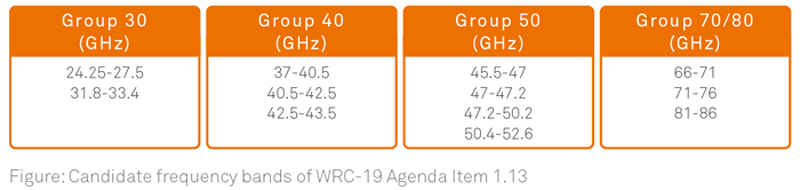
The World Radiocommunication Conference 2015 (WRC-15) paved the way for the future development of IMT on higher frequency bands by identifying several frequencies for study within the 24.25-86 GHz range (Figure 4) for possible identification for IMT under Agenda Item 1.13 of WRC-19. The 24.25-27.5 and 37-43.5 GHz bands are prioritised within the ongoing ITU-R work in preparation for WRC-19; all regions and countries are recommended to support the identification of these two bands for IMT during WRC-19 and should aim to harmonise technical conditions for use of these frequencies in 5G.

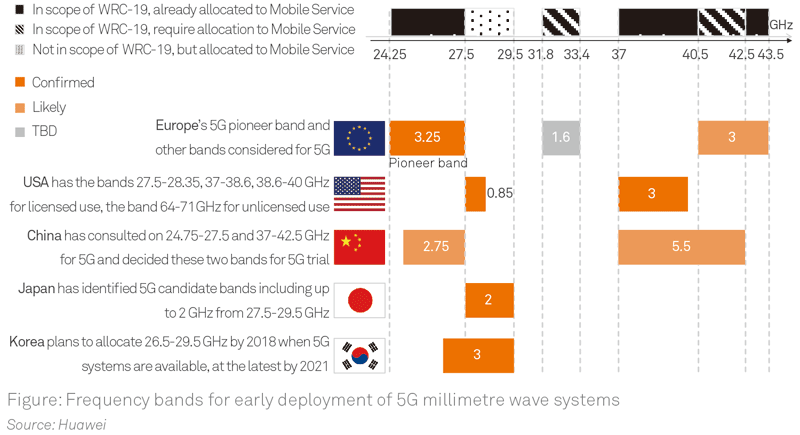
The frequency band of 27.5-29.5 GHz, though not included in the WRC-19 Agenda Item 1.13, is considered for 5G in the USA, South Korea and Japan.
The 24.25-29.5 and 37-43.5 GHz ranges are the most promising frequencies for the early deployment of 5G millimetre wave systems, and several leading markets are considering portions of these two ranges for early deployments (Figure 5), and the two ranges are also being specified in 3GPP Release 15 based on a TDD access scheme[3] . It is recommended that at least 800 MHz of contiguous spectrum per network from these ranges be assigned for the early deployment of 5G. For countries that plan to release 26.5-27.5 GHz as first step, it is recommended that at least 400 MHz of contiguous spectrum per network be assigned; the remaining 24.25-26.5 GHz should be allocated as soon as practicable and specific provisions should be added to avoid fragmented assignments across the overall 24.25-27.5 GHz range.

CEPT ECC PT1 is developing regulatory technical conditions for the 24.25-27.5 GHz band for mobile use in Europe, which may differ from the conditions agreed for 27.5-28.35 GHz in the USA. If this happens, it would be difficult to achieve spectrum harmonisation. Many other countries will decide the regulatory technical conditions for 24.25-27.5 GHz after WRC-19 confirms the criteria to protect incumbent services. These factors may delay 5G-NR ecosystem development for high frequency bands. Huawei encourages regulators to address these issues to allow the ecosystem over high frequency bands to be ready from 2020.
The L-band (1427-1518 MHz) is another 5G candidate band that has the potential to be allocated to mobile in most countries in the world. CEPT and CITEL regions have adopted the SDL (Supplemental Down Link) scheme for this band. The requirement for standalone operation in the band (both UL and DL transmissions) has emerged in some other regions. In the case of standalone 5G systems, a TDD access scheme is a potentially appropriate option, which can accommodate traffic asymmetry in the UL/DL directions with good potential for economies of scale. The same 5G-NR equipment can serve both the TDD and SDL markets.
The 700 MHz band has already been harmonised for mobile in most countries. Europe plans to use this band for 5G. Over the long term, the other frequencies of UHF band (470-694/698 MHz) could also be used for mobile, while the USA has already started the process of transferring the band from broadcasting to mobile service.
[1].GSA White Paper: "The future development of IMT in 3300-4200 MHz band", June 2017. https://gsacom.com/.
[2].China IMT-2020 Promotion Group, "IMT-2020 Trial Progress", a key note speech at the PT-EXPO China, September 2017
[3].3GPP RP-172115, "Revised WID on New Radio Access Technology"
Everything is about to change. Breakthroughs in connectivity, artificial intelligence, robotics, virtual reality, augmented reality, autonomous vehicles, wearables and the Internet of Things (IoT) will all impact our lives in ways we can't imagine. Underpinning these technological advancements is 5G.
The potential for 5G is awesome, but the potential to over-hype and under-deliver on the 5G promise is a temptation that the wireless industry must resist. If network providers, equipment manufacturers, handset makers, app developers and others in the wireless ecosystem engage in behavior designed to purposefully confuse consumers, public officials and the investment community about what 5G really is, we risk alienating the very people we want most to join in developing and harnessing this exciting new technology.
That's why we're calling on the broad wireless industry to commit to labeling something 5G only if new device hardware is connecting to the network using new radio technology to deliver new capabilities. Verizon is making this commitment today: We won't take an old phone and just change the software to turn the 4 in the status bar into a 5. We will not call our 4G network a 5G network if customers don't experience a performance or capability upgrade that only 5G can deliver.
Doing so would break an enduring and simple promise we've made to our customers: That each new wireless generation makes new things possible.
It is this belief that led us to bring together key device, chip and network equipment manufacturing partners to create the 5G Technology Forum with the goal of developing global 5G standards more quickly. The result was a commercial 5G offering a full two years ahead of original estimates. It's why we committed to build the first 5G Ultra Wideband network. It is the reason we opened 5G Labs to support entrepreneurs and innovators as they build the 5G applications that will change how we live, work and play. And it's the motivating factor behind our sponsorship of 5G development challenges focused on education, public safety, robotics and other critical areas where 5G can impact lives today and tomorrow.
We lead by example. And we challenge our competitors, vendors and partners to join us. People need a clear, consistent and simple understanding of 5G so they are able to compare services, plans and products, without having to maneuver through marketing double-speak or technical specifications.
Our industry knows 5G will change the world. Let's uphold that promise, while maintaining our integrity. The success of the 5G technological revolution must be measured in truth and fact, not marketing hype.

Expand with the momentum from last year, it is possible for users of Public Wi-Fi City networks , subscribers from a large list of operators to freely roam between these City Wi-Fi networks. The cities include: Barcelona (Spain), Dublin (Ireland), Dunlaoghaire (Ireland), Galway (Ireland), Limerick (Ireland), Bristol (UK), Leeds (UK), Birmingham (UK), Bradford (UK), Moscow (Russia), St Petersburg (Russia), Tokyo (Japan), Ebetsu city (Japan), Hokkaido (Japan), Mallorca (Spain), Nagano prefecture (Japan), Kyoto (Japan), Kobe (Japan), eduroam Japan / Tohoku University + Sendai, eduroam NL / Utrecht (Netherlands), eduroam NO / Trondheim (Norway), anyroam, eduroam US, Toronto (Canada)
Operators around the world include: AT&T, AnyRoamUS, Boingo, China Mobile, ER Telecom Russia, FON, iPASS, Orange, KT, NTT DOCOMO, Shaw, KT, Sprint, Telus, T-Mobile US, eduroam JP Tohoku University, eduroam NL / SURFnet, eduroam NO / UNINETT, eduroam US
Interconnectivity Partners & Infrastructure Providers: BSG Wireless, Syniverse Technologies, Global Reach, Accuris Networks, Cisco, Ruckus Wireless
The Wireless Broadband Alliance is encouraging cities, government bodies, fixed and mobile operators, technology vendors, Internet giants and service providers, as well as retailers, to come together to deliver connectivity to everyone, everywhere. The City Wi-Fi Roaming trial aims promoting and fostering the adoption of Next Generation Hotspot across the globe, working together with multiple cities around the world, key HUBs that make the data traffic possible, and also a set of operators.
Contact WBA (www.wballiance.com) now if you want to get involved the program: https://www.worldwifiday.com/support/